
Who Is Waterkeeper: Robert Burns, Detroit Riverkeeper
By: Thomas Hynes
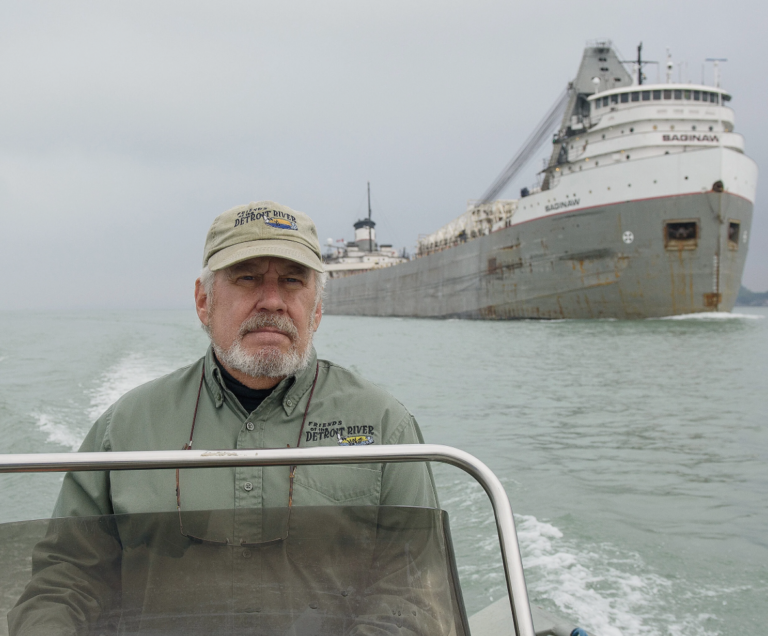
Robert Burns grew up on the Detroit River. As a teenager, he spent all of his free time on a boat where he would hunt, fish, camp, and explore the many islands and shorelines. The experiences gave him a first hand look at the river’s wildlife and habitats, as well as the impacts of industrial pollution.
After college, Bob took a job with a local marine contracting company. It was a way to stay on the water. In the late 1990s, he read an article about a group called Friends of the Detroit River. The organization was working to save the last contiguous mile of coastal wetlands along the Detroit River from being developed.
Bob decided to attend a meeting. Before long, however, he joined the group as a board member.
“Shortly after I joined the board one of our other board members attended a conference on the east coast that was held by a group called Waterkeeper Alliance,” says Bob. “He came back and reported to our board that this is a group that is doing nationally and internationally what we were trying to do here in the Detroit River. We decided to apply for a license to join Waterkeeper Alliance.”
But, there was a catch. In order to join, there had to be someone on staff to be the full time Riverkeeper. Bob was the natural choice. He had not only spent his life living and working on the river. He had also studied it quite a bit. In 2003, he became the first Detroit Riverkeeper.
The Detroit River is a crucial strait in the Great Lakes system, connecting Lake Erie with Lake Huron by way of the St. Clair River and Lake St. Clair. The 32-mile river runs in between the city of Detroit and Windsor, Ontario, making it an international boundary and important economic route. This strategic positioning gave birth to the city of Detroit. It would also lead to several decades of unregulated pollution. 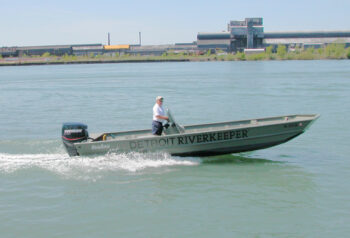
As the city of Detroit and its suburbs grew, so did its population and its economic activities. Fort Detroit, as it was known in the 1700s, was home to fur trading, then shipbuilding, and eventually heavy industry, earning Detroit its nickname as the Motor City. All this growth and activity would come to identify Detroit and its river. It also reshaped the landscape and affected the local environment, including some very serious downstream effects.
That can mean a bevy of toxic pollutants, including PCBs, 6PPD, PFAS, dioxin, and even mercury. That legacy of contamination would be bad in any waterbody, but it is particularly concerning for a river that provides the drinking water for roughly 5 million people.
Over the last 20 plus years, Detroit Riverkeeper has been actively working to address these issues. One of the things that the organization is particularly proud of is their ability to build good working relationships with local Federal, State and local agency staff, community leaders and civic organizations. It is through these relationships that they have been able to accomplish many positive outcomes for the Detroit River, including wetland protection, wildlife recovery, and habitat restoration. One successful restoration project, Stony Island, means the most to Bob.
“I grew up just across the river from this island, spent a lot of time hunting, fishing and exploring it as a kid. I saw firsthand the loss of wetland habitat and wildlife that occurred to this place from the effects of pollution,” says Burns. “I feel I have come full circle in being able to give back to a place that was so instrumental in developing my love of the river.”
There has been tremendous progress on the Detroit River’s rehabilitation. But the threats remain. Bob rightly recognizes that he can’t be on the river all of the time to catch every incident. To address this problem, the Detroit Riverkeeper started the Report Marine Pollution program, where local residents, boaters and fishers can alert the organization, who will investigate the incident. If warranted, they will then forward the issue to the attention to the appropriate state or federal agency.
Looking ahead, Detroit Riverkeeper is turning their efforts towards addressing the approximate 5 million cubic yards of contaminated sediment in the Detroit River. They will be working directly with the U.S. Environmental Protection Agency (EPA), Michigan’s Department of Environmental, as well as local partners to address the contaminated sediment issue.
Two decades worth of accomplishments working as Detroit RIverkeeper suggests that Bob will find success in these efforts, too.
“Two of the things that I believe are essential in being a successful Riverkeeper is never give up and don’t take no for an answer. There are solutions to every problem if you are willing to put in the effort and not back down,” says Bob. “Relationship building is also important in being able to get things done. Also, the willingness to work with those on both sides of the issues towards an agreeable solution, but not be afraid to push for regulatory measures when needed.”
Learn more about how you can support Bob and Detroit Riverkeeper here.