
Who Is Waterkeeper: Erin Donmoyer, Black-Sampit Riverkeeper
By: Thomas Hynes
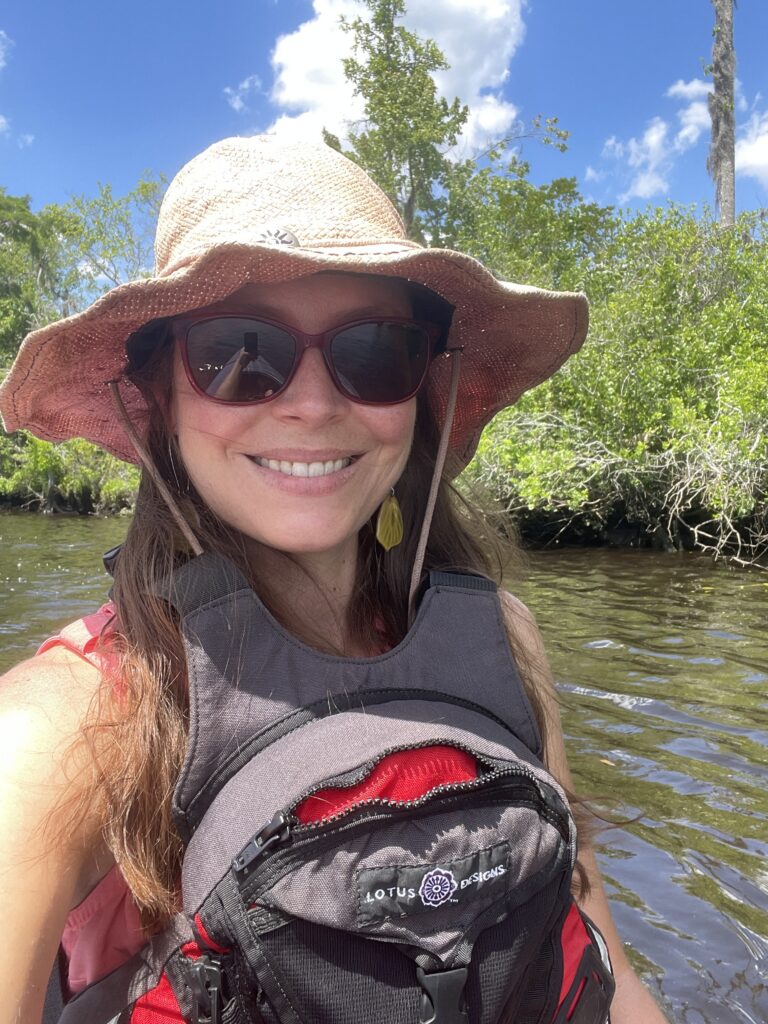
Erin Donmoyer has been the Black-Sampit Riverkeeper in South Carolina since 2022. Her journey to this role, however, took thousands of miles. Erin grew up in South Carolina, but moved to Alaska as a kid. She would eventually attend Alaska Pacific University in Anchorage, where she met Christian Breen, the current Movement Building Manager for Waterkeeper Alliance. After a brief stint as a farmer and innkeeper in Vermont, Erin moved home to South Carolina to help family. She was also looking for a new job, ideally something in conservation. Her old friend Christian suggested she become a Riverkeeper.
“It was just so random that there was a position available in Middle-of-Nowhere, South Carolina where I was returning to,” says Erin. “Christian’s description of the job may have been a bit inaccurate. He said I’d be fishing and kayaking all day. In reality, those moments are a small but rewarding part of the job. Most days involve scientific investigation, advocacy, problem-solving, public outreach, and navigating complex environmental issues.”
Black-Sampit Riverkeeper is housed within the Winyah Rivers Alliance, a group of Waterkeeper organizations in North and South Carolina that protect the watershed in and around Winyah Bay. In her role, Erin watches over 2,245 square miles, 2,080 square miles of the Black River watershed and 165 square miles of the Sampit River watershed. 
The rivers are fed by bottom land hard wood swamps that are rich in the organic materials that make the water appear black or like darkly-stained sweet tea. One of the most striking features are the centuries-old cypress trees. Some compare the area to the Amazon of the United States.
“I have always loved the swamps around here,” says Erin. “These are powerful and magical spaces. They are deep and mystical, and easy to get lost in. They have witnessed all of the awful and beautiful things that have happened in the south over the centuries. They also serve a hugely important purpose in times of floods.”
Since taking on this role, Erin has encountered many challenges. But in many ways those obstacles have also become her biggest successes.
One of the first things Erin did as Black-Sampit Riverkeeper was to participate in Waterkeeper Alliance’s 2022 PFAS study. Unfortunately for the river, her samples uncovered significant contamination. Erin used that information to inform the public.
“One accomplishment I’m especially proud of is helping advance the conversation around PFAS pollution in the Black River watershed. PFAS are an emerging concern across the country, and I’m proud that we’ve been able to bring attention to the issue, gather meaningful data, and advocate for protecting our communities and waterways from these persistent contaminants,” says Erin. “PFAS is really playing a part in hurting the practice of subsistence fishing, and I want to help make it safe again.”
Another challenge Erin has faced has been working within a regulatory system where environmental protections or enforcement don’t always keep pace with the threats waterways face. Other times, it feels like the authorities are siding with industry. In an ideal world, a pollution issue would be investigated and addressed. In South Carolina, however, that hasn’t always been the case. For Erin, that means advocacy, persistence, and community engagement become even more important.
 Recently, a local developer sought an exception to a local ordinance that would have harmed local waterbodies. Over a week period, four different people reached out to Erin to help fight it. Eventually, the ordinance request was denied. It was more than a victory for clean water, though. It signaled to Erin that she had truly become a trusted resource for the community.
“There’s a steep learning curve. You can’t just step into this job and go,” says Erin. “The community engagement piece is so huge. And it takes a lot of time to get your name out there and for people to know who you are and that they can trust you. It felt like I finally made it. It’s working, but it took four years to get there.”
A more positive development In Erin’s watershed is the development of the Black River State Park. It’s South Carolina’s first linear and riverine state park. The 70-mile park will showcase the river’s magnificent cypress forests and provide South Carolinians with a unique open space. It will also provide Erin and Black-Sampit Riverkeeper with a tangible example of what they are trying to protect.
“People often think environmental science and conservation is something only scientists do, but everyone has a role,” says Erin. “Get out on the river. Paddle it, fish it, walk along it. Pick up trash when you see it. Support local conservation efforts. Pay attention to what’s happening in your watershed, and if something doesn’t look right, speak up. Common institutional knowledge and familiarity have great power. The more people know these rivers, the more they’ll care about protecting them.”
Learn even more about Erin and how to support her work here.