
The Veins of the Earth, the Rivers of the Soul: The Journey of Espíritu de Río
By: Monica Aguilar V.
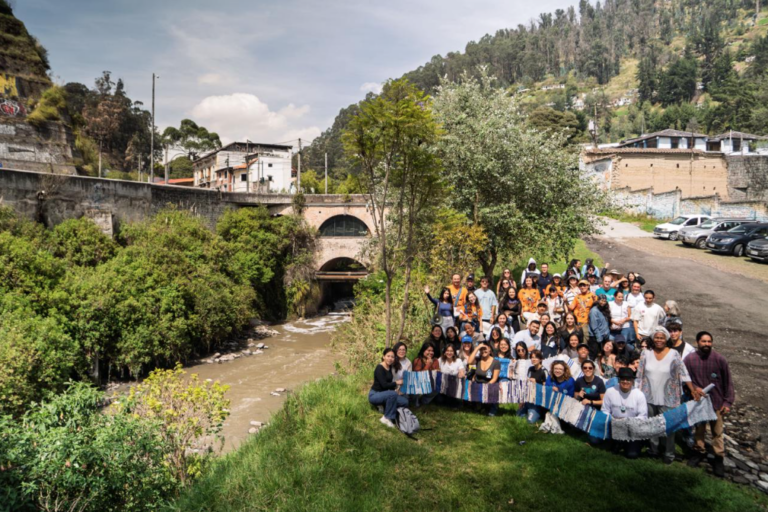
“What happens in our bodies when a vein or artery is blocked? The same thing happens in cities when ravines are covered and rivers are polluted, since they are the veins and blood of the Earth.” — Espíritu de Río (River Spirit).
In an era defined by ecological crisis, modern urban planning has long treated rivers not as living, breathing entities, but as inconveniences to be channeled, piped, and buried beneath asphalt and concrete. Yet across the globe, a profound awakening is taking root. Communities are remembering that cities do not conquer nature; they merely build over it.
In Quito, Ecuador—a city cradled by volcanic peaks and carved by ancient glacial waters—one collective is leading a radical, poetic, and deeply spiritual charge to reclaim these forgotten waterways. Known as Espíritu de Río (River Spirit), this grassroots network is redefining what it means to protect water. By weaving together ancestral Andean cosmovision, contemporary art, community science, and legal advocacy, they are proving that to heal our rivers, we must heal our relationship with water both without and within.
The Cosmos in a Drop: The Philosophy of Espíritu de Río
At the heart of Espíritu de Río lies an ancient hermetic principle: As above, so below. Water is not conceived merely as a chemical resource, but rather as a sacred, non-renewable connective tissue of the planet that unites all—human beings, fauna, flora, and the rest of the elements—into a single biosphere.
In the ancestral Andean worldview, human beings are indivisibly one with nature. The majestic mountains that tower over Quito are not cold rock; they are our Mamas and Taitas (mothers and fathers), providers of shelter and nourishment. Water itself is envisioned as a winged serpent—a living force of immense wisdom that must be approached with profound respect, allowed to self-regulate, and never aggressively intervened upon.
This philosophy carries a striking biological truth: just as rivers are the Earth’s circulatory system, our own bodies are comprised of 70 to 80 percent water. When cities choke their ravines with garbage and cement, they effectively induce a stroke in the planetary body, mirroring the physical, emotional, and spiritual malaise experienced by urban citizens.
Espíritu de Río was born to lift this veil of amnesia, restoring the sacred geography of water in the collective imagination.
From Dreams to Watercolor: The Genesis of Samayuio
Every great movement begins with a vision. For Espíritu de Río, that vision materialized in 2019 through Mónica Aguilar V. (Saokma), a photographer haunted by dreams of Quito’s lost and forgotten rivers beneath the historic city center.
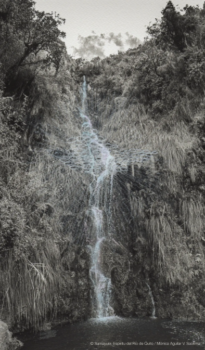
Through her artistic project, Samayuio, Espíritu del Río de Quito, Mónica visualized the original paths of water—springs, cascades, rivers, ravines, and lagoons—that once flowed freely from the highlands of the Pichincha volcano down to the Machángara River. Using photographs illuminated by hand with watercolors, she created a visual bridge across time and dimensions.
This artistic journey mirrors the Andean cosmology of Hanan, Kay, and Uku Pacha (the upper, middle, and lower worlds). The water emerges from the historic Quitu-Cara cascade, journeys through city streets and human bodies, and eventually returns to the Taita Rucu (the father volcano) to cleanse its history, uniting past and future in coherence with Mother Earth.
From Art to Action: Catalyzing a Citizen Network
What began as a solitary artistic quest soon blossomed into a collective movement. In 2021, art therapist Camola and ecologists Marcia Valarezo joined forces with Mónica, bringing a shared passion to turn photographic visions into tangible ecological reality.
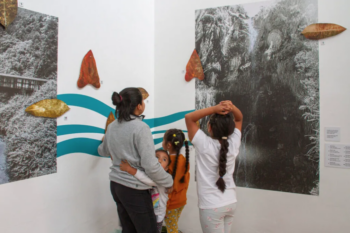
River Symbols 2024 exhibition at the Science Interactive Museum, MIC
©Mónica Aguilar V.
November, 2024 / Quito – Ecuador.
The turning point for civic mobilization came on February 1, 2022, following a devastating mudslide (aluvión) in Quito. Recognizing that ecological disaster is the direct consequence of severed ties with natural watercourses, Mónica convened a circle of specialists and civil society members. This gathering birthed permanent collaborations with organizations like the Colectivo de Rescate del Río San Pedro, the creation of creative incubation spaces like El Telar del Río, and a formidable citizen network dedicated to recovering river memory and health.
This grassroots solidarity recently achieved a monumental victory: in May 2024, Espíritu de Río joined forces with over 30 civilian collectives and institutions to stood as advocates in presenting the historic Action of Protection for the Machángara River (Acción de Protección del Río Machángara), securing a groundbreaking favorable ruling that recognizes the rights and ecological urgency of Quito’s most battered urban river.
Activities That Mend the Fray
Espíritu de Río understands that true conservation cannot be sustained by policy alone; it
requires cultural regeneration. Their multi-faceted activities actively mend the fray between humans and watersheds:
- Artistic Reflection and Exhibitions: Through collections like Samayuio, Telar del Río Símbolos del Río (River Symbols) and multiple collective exhibitions, art serves as a mirror reflecting the sacred bond between human identity and endemic ecosystems.
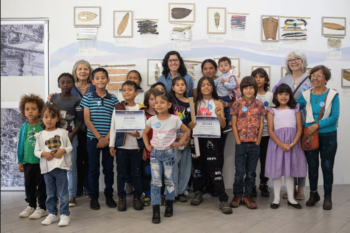
- Sensitive Education & Children’s Workshops: The Samayuio Children’s Art Workshops, the Fotofilia Club and Vecin@s del Machángara Program (The Machangara River Neighbours) cultivate a new generation of water stewards, teaching children, young adults and seniors to perceive rivers not as drains, but as living relatives and sacred entities.
- Watershed Walks (Caminatas de Vinculación): By walking the hidden ravines and meeting the living springs of the city, citizens physically re-trace the veins of their homeland, transforming abstract ecological data into a visceral, emotional homecoming.
A Keynote for the Global Waterkeeper Movement
The story of Espíritu de Río offers a vital keynote for Waterkeepers and environmental defenders worldwide. Protecting water requires more than monitoring pollution levels or filing lawsuits—though those tools are essential. It requires reconnecting your relationship with water from the very depths of the human being while recovering the value and importance of art practice and application.
When we recognize that our internal waters and Earth’s external rivers share the same pulse, conservation transforms from an obligation of burden into an act of profound self-love and planetary healing. Art practices engange with human beings on multiple levels: sensorial, mental and physical. By promoting the arts as channel and shared practices, we can make data visible while creating an holistic movement that ensures water conservation for the future.
As Espíritu de Río continues to create artwork and walk the banks of Quito’s hidden waters, they remind us all of our ultimate calling: to listen to the whispers of the winged serpent, to honor the mountains that cradle us, and to restore the sacred flow of life—both above and within.
For more information on the River Spirit, foster collaboration or just “join the flow”, please visit: espirituderio.com and follow its activities on instagram @espirituderio.
This guest blog was written by Mónica Aguilar V. (Saokma), a visual artist, designer, and photo therapist based in Quito, Ecuador. She is known for her work in therapeutic photography and visual pedagogy, including projects connected to environmental initiatives such as the San Pedro River cleanup. Mónica also provided photography services for Waterkeeper Alliance’s 2026 Global Conference in Quito.