
New Report Provides a Pathway to Secure Clean Water Protections at the State Level
By: Waterkeeper Alliance
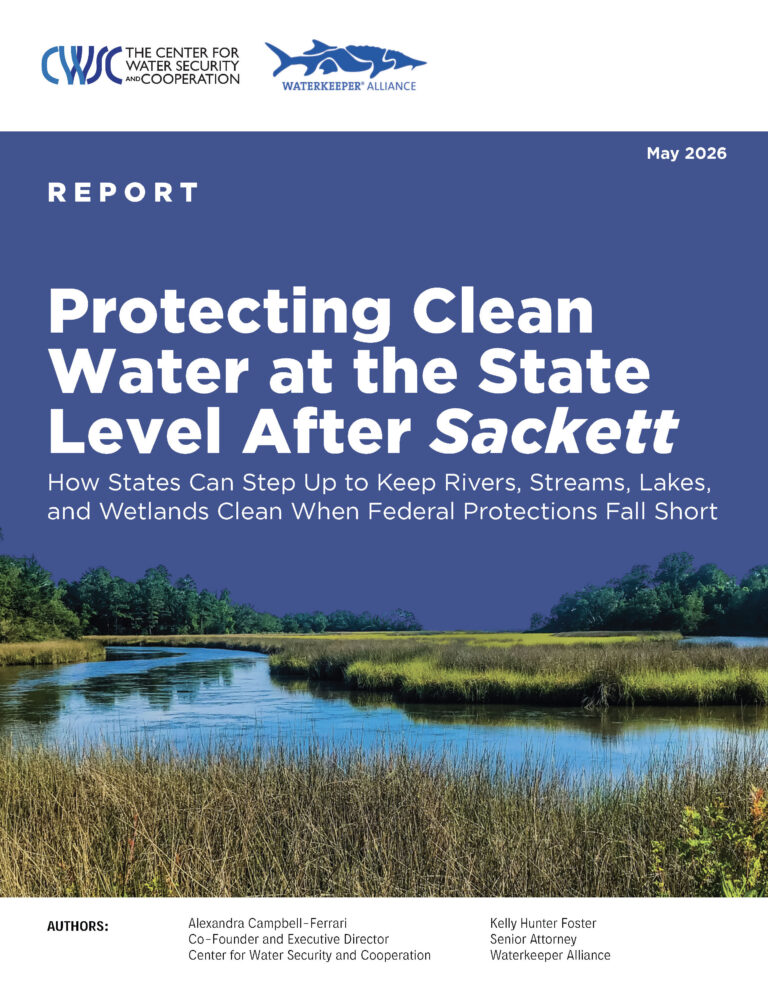
Today, Waterkeeper Alliance and the Center for Water Security and Cooperation released Protecting Clean Water at the State Level After Sackett, a new report offering a practical playbook for community members and elected leaders to strengthen water quality protections at the state level.
The report addresses gaps created by the Supreme Court’s Sackett decision and the resulting narrowing of the U.S. Environmental Protection Agency (EPA) and U.S. Army Corps of Engineers’ definition of “Waters of the United States” (WOTUS).
“This report shows that not all hope is lost. We have opportunities through state laws to better protect water quality,” said Kelly Hunter Foster, Senior Attorney at Waterkeeper Alliance. “Our hope is that community leaders will take the recommendations we’ve outlined in this report and work with their local elected officials to develop and amend their state legislation and regulations to enable greater water quality protection.”
The release of the report comes at a critical time, as EPA is expected to finalize a rule that could further narrow the scope of WOTUS. The agency’s own analysis shows that under the proposal, more than 80 percent of mapped wetlands in the continental United States could lose federal protections. This shift could place greater responsibility on states to protect local waterways in the absence of broader federal oversight.
Specifically, the report examines laws in four states in the lower Mississippi River basin—Arkansas, Mississippi, Missouri, and Tennessee—and assesses where existing statutes and regulations fall short in enabling state agencies to protect water quality under a more limited scope of the Clean Water Act. After identifying these gaps, the report outlines opportunities to strengthen existing laws and regulations in each state, with a goal of improving water quality protections and ensuring greater continuity across shared watersheds.
“States can keep our drinking water clean. States can keep the rivers we fish clean. States can make sure the rivers and lakes we swim in won’t make us sick. States are in the driver’s seat, and this report gives them the tools they need to keep America’s waters as one of our biggest assets. This country was built on these resources. As we celebrate 250 years as a country, we have to rededicate ourselves to keeping our waters healthy so that our country can last another 250 years. This is the role States can and must play, and this is what every citizen should demand,” said Alexandra Campbell-Ferrari, Executive Director of the CWSC.
While the report focuses on state-level gaps, the consequences of narrowing WOTUS reach far beyond those boundaries. In addition to wetlands, narrowing the scope of waters protected under the Clean Water Act removes federal safeguards from countless rivers, streams, lakes, and other vital waterways.
This undermines decades of clean water protections and puts water quality at risk across the country. Without consistent federal oversight, these waters face greater exposure to pollution, threatening drinking water sources, recreational uses, fisheries, and aquatic ecosystems.